Showing posts with label success. Show all posts

Friday, February 7, 2014

What Type of Leader Are You?

DISCLAIMER:  One of my more rambling Blogs - meant to help me 'work a thought out' to learn from it.
I share it here, in the hopes that it might shine some light on a situation you may be facing.  SW


I'm having difficulty starting this Blog because my thoughts and opinions and memories of experiences are all over the place... But it's really on my mind this topic of 'Leadership'.  There are some of the traditional types of leaders to choose from:
  •   It's my way or the highway!
  •   I want to know what you think, I need your feedback but ultimately...it's my decision
  •   I'm giving you complete freedom to get this done...I have other things to do.
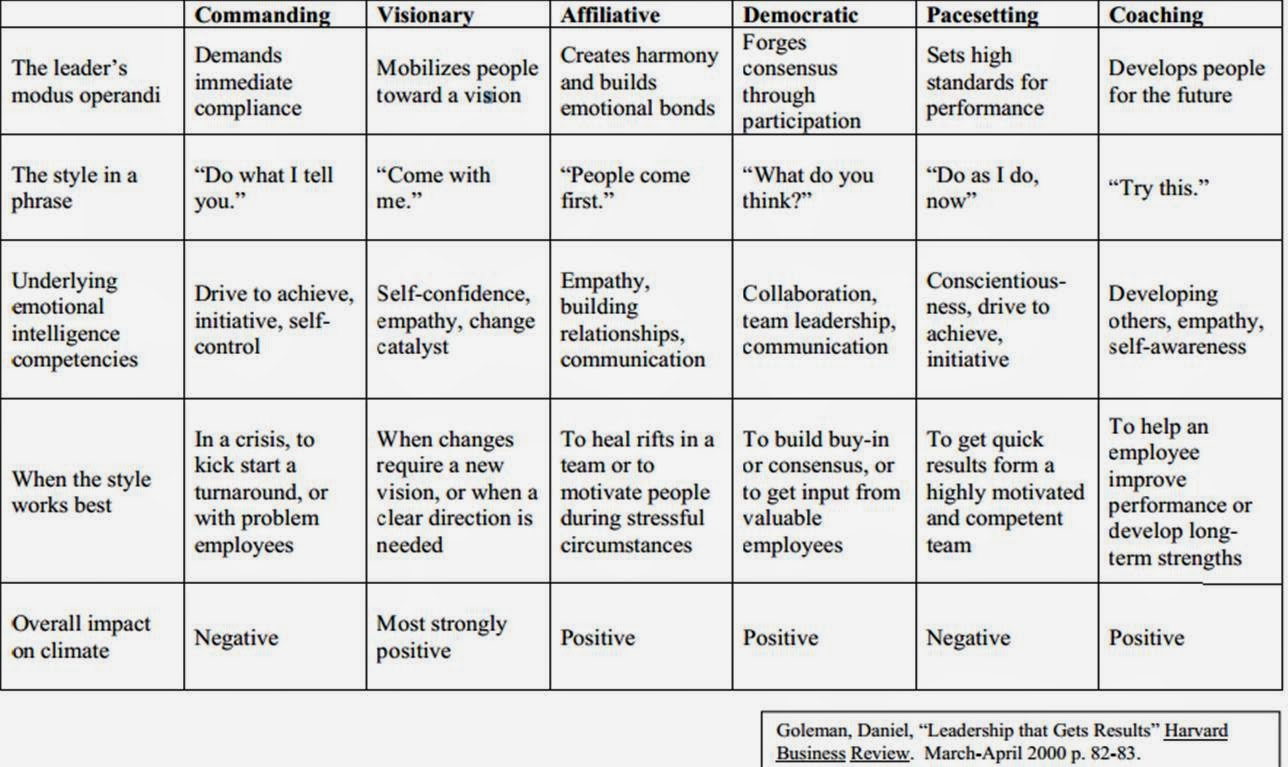
I think what I am more interested in is the breakdown of Emotional Leadership.  Actually,  until I wanted to write this Blog I didn't even know they had a category for this and that they have specific names.  I did some research and apparently there is a man named Daniel Goleman and he has a whole 'thing' around this 'emotional intelligence' and how it can be applied to Leadership.  He differentiates between TYPES of Leaders and STYLES of Leaders.  

Here are the  STYLES of Leadership:  
Commanding:
Visionary:
Affiliative:
Democratic:
Pacesetting:
Coaching:

I will summarize a nice little chart below that compares all of these, but for my own purposes I think I am most interested in exploring Visionary - Affiliative - Coaching.  These seem to have a positive effect but I have to wonder, if these aren't coupled with a balance of teaching, correcting, and actually offering practical skills, if these types of Leadership Styles actually show long term success.  

For example:  I am familiar with a leader who is great in his own right and with a Visionary - Affiliative-Coaching style of Leadership he has inspired and motivated large crowds of people to 'keep on keeping on'.
When things were tough, when people couldn't see the light at the end of the tunnel and when we couldn't believe in ourselves his encouragement carried us over until we could see the light and we could believe in ourselves and those around us.  

He could take a person who had raw potential and could inspire them to try.  He was very relational and he created harmony through a common goal. His end result was to hold you up, until you started to believe the hype and could fulfill that vision.

This sounds great right?  

Well not so much, when it came to being organized, communicating clearly, and teaching .  Others took on that role.  While he was inspiring us to believe, someone else was teaching us how.  While he was looking to the future, someone else was in the moment and handling the day to day issues.  

When he left the company, those that he had 'raised up' or 'mentored' were some of the most positive people and their self - confidence was off the chart but their ability to lead a project, delegate responsibilities, follow up on tasks and communicate the details were non-existent.

What is more important? Is that real Leadership success?  Is it a question of priorities? Where is the balance?   I look at this type of Leadership and I think that it's needed, but it can also be so hurtful to those that you "Lead" if you can't follow through.  When our Leader left, he left behind great people but with no skills.  So now we have projects with no real clarity or direction.  We have no communication between the managers and sadly enough we don't have those types of people in the organization who can do these things because they got frustrated long ago and moved on to other projects in the building.  

I recognize that these STYLES of Leadership are needed and can have positive outcomes but I really believe that this kind of relational - orientated Leadership has to parallel some sort of organizational - orientated Leadership.   

MBA-LEADERSHIP-TYPES Software Strategy Model Framework Analysis Management

My last thoughts are this:  Balance...Yin/Yang...Right side/Left side - It's all about putting the pieces together. This last leader was fantastic at the People Focus(left side of chart above) but in order to be really successful you HAVE TO be able to balance that with Task Focus.(right side of chart above) 

Being Task Focused is the other half of the complete picture.  It's about the organization as a whole and tackling those Leadership skills and behaviors that are needed for success.  I like to think that I am a balanced leader. In probability I can tend to get task focused, and I could need some mentoring in Business Leadership.  I guess the point is - We can all improve somewhere - the first step is recognizing what we are missing and then pursuing it in order to create a more balanced leader.  What are you pursuing today?  Where are you lacking?  Who is in your life that can help you in an area where you can improve?  I wish you the best of luck as you continue on this journey.


**Would you like to know a fun fact?  As I was closing the article down and sharing my feelings I went to Google to find an image for my BLOG and the above chart showed up which PRECISELY summed up what I was struggling with understanding.  It's amazing how small a world we really do live in.  

Thanks for reading, please feel free to post a question, comment or your own experience of unbalanced leadership and how it turned out for you.  

Styles Chart (as referenced above)

                Tuesday, January 28, 2014

                How Do You Communicate?


                Too often we think of communicating as someone telling someone something...when in fact that is just talking!  If there isn't someone on the other end of that talking who is listening and responding we are just sending our words into the black hole of nothingness.

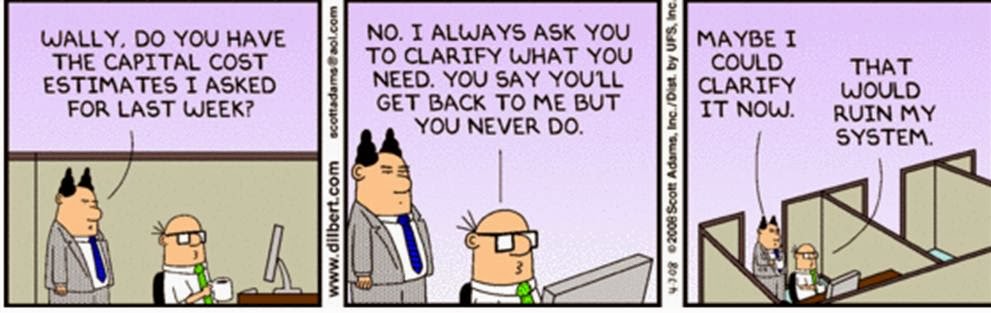
                We've heard it said that two-way communication is paramount to success and nothing is more true than that statement when it comes to succeeding in business.  We laugh at the cartoon above but how often has someone asked us to do something and then when it doesn't get done we say..."well... I did ask you about...".   Too often we are quick to blame someone else for a dropped ball.

                Good communication is both giving and receiving until the cycle is complete and the end goal has been either accomplished or changed.  In addition to exchanging information it's also about understanding that information.  I can sit and listen to a man speak German to me for an hour and I can respond in English and he can then respond in German and we can go back and forth but unless both of us are bi-lingual there will be no understanding and therefore no real communication.

                In today's society there is no greater opportunity for miscommunication than right now.  We email, we text, we instant message, we do everything but walk down the hall or across the room to communicate with our co-workers.  But one of the greatest tools we have and what separates us from the rest of the crazy animals in the zoo is the ability to speak and to be understood.  

                Effective communication is vital to the success of a business. It helps build trust and creates an environment where creative ideas and problem-solving are welcomed and encouraged. When there is no open communication, miscommunication or misunderstanding is often the result, causing conflict and frustration among team members. Heads of organizations need to understand that good communication and leadership is tied closely together. In this age of real-time data, we process a lot of information on a daily basis. The messages that are being sent through text messaging, emails, instant messaging and even social media platforms cannot be the only form of communication that we have in our teams.

                Effective Communication Starts with Listening
                Listening is an important skill to master. It's not just hearing the words that are being said but also understanding and connecting with what the person is saying. If you want to create an atmosphere where your co-workers feel valued and inspired to freely share ideas, then you will need to hone your listening skills in order to fully connect.
                ·         When conducting meetings, you must create an environment in which your team feels safe to freely express their ideas and opinions whether they agree or disagree with you. Make it a forum where each person can resolve issues in a creative way.
                ·         Do not interrupt team members when they are speaking. When team members are airing their ideas and you don't agree with what is being said, instead of thinking about your response, really listen to what is being said.
                ·         Focus fully on who is speaking. In this age where it is so easy to be looking down at our smartphones or checking emails during online meetings, we tend to miss out on important details of what is being said.
                Sharpen Email Skills
                Let’s face it.  Email is the most used form of communication when it comes to running a business.  As a leader in your organization, you will need to be able to manage your inbox in an efficient manner and train those around you to answer emails promptly especially regarding any customer related issues.
                ·         Train everyone to reply to emails in a clear and concise manner. Make sure to address the important key points in your reply to avoid unnecessary back and forth.
                ·         If you cannot act on a message or a request by a team member right away, send a quick note letting them know you will get back to them soon. Don't leave them hanging.
                ·         If there are documents that need revisions and team collaboration, use tools that can be accessed by the team instead of sending it as an attachment.
                ·         If a communication issue cannot be resolved by email, pick up the phone to make sure the message is clear and nothing is left to chance.
                Manage Stress for Effective Communication
                Being overly stressed can lead to poor communication especially when most of your communication is accomplished over email. Poorly written messages can easily be misinterpreted and tend to send misleading signals which can disrupt your capacity to think clearly and communicate creatively and effectively. Postpone communication or sending emails when you are stressed. Take time to calm down before engaging with your clients and team.
                Remove Barriers In Communication
                Effective communication can only become easier when team members get to know each other better.  Touch base once a week to discuss where you are, how you’re doing and what’s about to take place.  Share your ups and downs and share your challenges so that others around you can have the opportunity to listen and to advise (if needed).   For those employees that can’t always be on site hold meetings via SKYPE or FACETIME. 
                Meetings don't have to be lengthy. Make it a priority to discuss goals achieved for the week and team objectives for next week. Encourage your team to call you directly when urgent matters needs to be discussed so that workflow is not unnecessarily disrupted. This practice is something that I found quite useful. It allows for fast turnaround in problem solving and creative discussion in real time.

                Great communication won’t solve ALL of your team problems, but it does go a loooong way in helping to bridge the gap.  Ask yourself how you can improve your own communication style and then hop to it!!

                Best of Luck,
                Sarah 

                Thursday, January 19, 2012

                Set Your Mind to SUCCESS!!

                5 Powerful Mind Success Strategies 

                Building a business is a fantastic and challenging experience.  You can wake up exhilarated to begin your day and go to bed feeling overwhelmed and frustrated.  The key to success is to maintain a positive, yes you can do it, mindset.
                Easier said than done, right? 


                Here are 5 keys to help you create and sustain a positive mindset so you attain the success you desire.

                1. Surround yourself with successful and positive people.  The influence people have over our own personal energy is amazing.  Moods and attitudes are so easily spread – think about how much of a difference a simple smile from a stranger can make for your day and then magnify it 1000 times to demonstrate the power of positive and successful friends, family and associates.  When you have people around you who inspire you, believe in you and want you to succeed, there’s no room for doubts and even when they creep up, they’re quickly swept away. 

                2. Create a mantra or an affirmation.  Repeating positive affirmations has been shown to get people through tough times and to actually help them truly believe what they’re saying.
                For example, “I am building a powerful and profitable business.”  Many of the most esteemed business professionals have used the same affirmation strategy to attain their success.  To find the right affirmations for you, consider writing a quick list of your doubts, insecurities and complaints.  These can then be quickly turned into affirmations.
                For instance, if you write that you’re always feeling disorganized then your affirmation would be, “I am organized and in control.”  Repeat your affirmations several times a day and feel the power of positive thinking.

                3. Capture negative thoughts.  We all have negative thoughts from time to time, however, negative thoughts and emotions can derail us and prevent us from achieving all we desire.  Of course catching those negative thoughts takes practice and persistence.  When you find yourself thinking negative thoughts or having negative emotions, find a trigger to turn them around.  The affirmations mentioned above are a great way to turn the negative into the positive.  You can also find quick pick me ups like a favorite song, a walk outside in the fresh air, or some exercise to help improve your mood.

                4. Set goals/intentions and then be willing to let it go.  The law of attraction says that we attract what we focus on the most.  However, desperation, needing your business to be a success, sends mixed messages and a lot of negativity into the universe.  Set your goals and intentions and then let them go.  A certain amount of faith in yourself and in the power of attraction is necessary.  Give it a try.

                5. Be grateful.  Gratitude is perhaps the single most powerful and positive tool for success.  When you’re grateful for all of the wonderful things and people in your life the challenges you face seem significantly less important and are more easily dealt with.
                Consider keeping a gratitude journal and make a practice of entering into it daily.  That way, when you’re facing challenges a quick peek at all the amazing things in your life will make you feel as if you can tackle anything.   Additionally, an attitude of gratitude helps you maintain a positive perspective and to face challenges as opportunities rather than obstacles.

                Success is within your reach and with the right attitude you can accomplish anything you set your sights on.  Embrace these five powerful mind success strategies and you’ll build a better business and live a happier, more satisfying life.


                Hip Chicks eNews - Mindset Matters