Tuesday, January 28, 2014

How Do You Communicate?


Too often we think of communicating as someone telling someone something...when in fact that is just talking!  If there isn't someone on the other end of that talking who is listening and responding we are just sending our words into the black hole of nothingness.

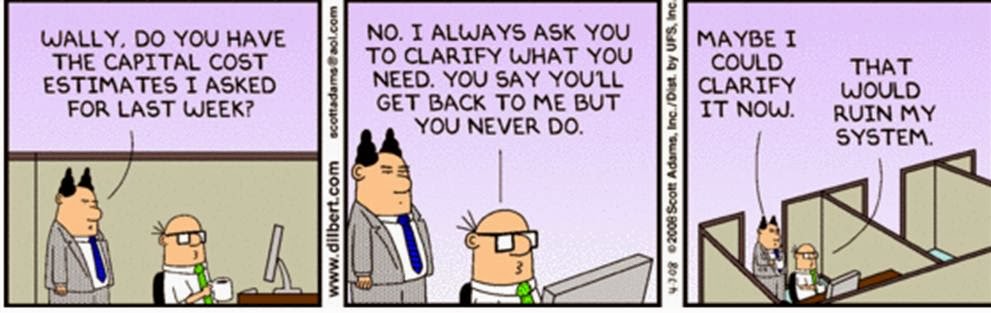
We've heard it said that two-way communication is paramount to success and nothing is more true than that statement when it comes to succeeding in business.  We laugh at the cartoon above but how often has someone asked us to do something and then when it doesn't get done we say..."well... I did ask you about...".   Too often we are quick to blame someone else for a dropped ball.

Good communication is both giving and receiving until the cycle is complete and the end goal has been either accomplished or changed.  In addition to exchanging information it's also about understanding that information.  I can sit and listen to a man speak German to me for an hour and I can respond in English and he can then respond in German and we can go back and forth but unless both of us are bi-lingual there will be no understanding and therefore no real communication.

In today's society there is no greater opportunity for miscommunication than right now.  We email, we text, we instant message, we do everything but walk down the hall or across the room to communicate with our co-workers.  But one of the greatest tools we have and what separates us from the rest of the crazy animals in the zoo is the ability to speak and to be understood.  

Effective communication is vital to the success of a business. It helps build trust and creates an environment where creative ideas and problem-solving are welcomed and encouraged. When there is no open communication, miscommunication or misunderstanding is often the result, causing conflict and frustration among team members. Heads of organizations need to understand that good communication and leadership is tied closely together. In this age of real-time data, we process a lot of information on a daily basis. The messages that are being sent through text messaging, emails, instant messaging and even social media platforms cannot be the only form of communication that we have in our teams.

Effective Communication Starts with Listening
Listening is an important skill to master. It's not just hearing the words that are being said but also understanding and connecting with what the person is saying. If you want to create an atmosphere where your co-workers feel valued and inspired to freely share ideas, then you will need to hone your listening skills in order to fully connect.
·         When conducting meetings, you must create an environment in which your team feels safe to freely express their ideas and opinions whether they agree or disagree with you. Make it a forum where each person can resolve issues in a creative way.
·         Do not interrupt team members when they are speaking. When team members are airing their ideas and you don't agree with what is being said, instead of thinking about your response, really listen to what is being said.
·         Focus fully on who is speaking. In this age where it is so easy to be looking down at our smartphones or checking emails during online meetings, we tend to miss out on important details of what is being said.
Sharpen Email Skills
Let’s face it.  Email is the most used form of communication when it comes to running a business.  As a leader in your organization, you will need to be able to manage your inbox in an efficient manner and train those around you to answer emails promptly especially regarding any customer related issues.
·         Train everyone to reply to emails in a clear and concise manner. Make sure to address the important key points in your reply to avoid unnecessary back and forth.
·         If you cannot act on a message or a request by a team member right away, send a quick note letting them know you will get back to them soon. Don't leave them hanging.
·         If there are documents that need revisions and team collaboration, use tools that can be accessed by the team instead of sending it as an attachment.
·         If a communication issue cannot be resolved by email, pick up the phone to make sure the message is clear and nothing is left to chance.
Manage Stress for Effective Communication
Being overly stressed can lead to poor communication especially when most of your communication is accomplished over email. Poorly written messages can easily be misinterpreted and tend to send misleading signals which can disrupt your capacity to think clearly and communicate creatively and effectively. Postpone communication or sending emails when you are stressed. Take time to calm down before engaging with your clients and team.
Remove Barriers In Communication
Effective communication can only become easier when team members get to know each other better.  Touch base once a week to discuss where you are, how you’re doing and what’s about to take place.  Share your ups and downs and share your challenges so that others around you can have the opportunity to listen and to advise (if needed).   For those employees that can’t always be on site hold meetings via SKYPE or FACETIME. 
Meetings don't have to be lengthy. Make it a priority to discuss goals achieved for the week and team objectives for next week. Encourage your team to call you directly when urgent matters needs to be discussed so that workflow is not unnecessarily disrupted. This practice is something that I found quite useful. It allows for fast turnaround in problem solving and creative discussion in real time.

Great communication won’t solve ALL of your team problems, but it does go a loooong way in helping to bridge the gap.  Ask yourself how you can improve your own communication style and then hop to it!!

Best of Luck,
Sarah 

Thursday, January 23, 2014

Life: The Big Picture

Life is all about perception. What one person sees as reality may be completely different from what another person in the same situation may see. It all depends on how our individual thoughts, feelings, and behaviors shape our world. If we could only take a step back and look, I mean really look, at how we react to situations and interact with other people, we would learn so much about ourselves. It is in this self-awareness that we ultimately find happiness, living life in the "big picture."

It's common knowledge around here that I am looking to head to a different city and state to be with  my family.  It's been a year since I moved my mother and all of my possessions 1/2 way across the country.  It's been 4 months since I've actively been pursuing job leads and submitting resume after resume.  

There is of course that temptation to look at this one small facet of my life and think no-one is hiring, no-one wants to pay me what I'm worth, no-one wants to hire someone from out of town when they can hire someone right now.  The list can go on and on for days and days and my perspective can become one of negativity, self-doubt and blame.  

As mentioned above, life is ALL about perception.  If this is how I am going to perceive my life, the sum total of everything I have done and worked for then that perspective, that attitude is shaping my world AND not for the better. 

My life is my choice.  Can I choose whether or not someone hires me? No, but I can choose to learn and change from the experience and I can respect the fact that we may not be the right fit at the right time.   

In any situation I can choose to step back and see the big picture.  I can ask questions, I can share experiences and knowledge, and I can respect the decisions of those who had to make a tough choice.  My other choices include sitting back and blaming others, criticizing the process, and denying that there isn't something I can be learning and growing into as a result of this job search.


I am choosing to live Above The Line.  I am choosing to live life in the Big Picture.  I am choosing to be grateful for a fantastic job that allows me to work while job searching and supporting my desire to be closer to my family.  I choose to always be looking just around the corner for the right job at the right time who needs the right person (ME) and that it will happen at the right time.

How about you?  Are you living above the line?  Are you taking each experience and choosing to see it in a positive and helpful manner?  Are you living life to the full and seeing the Big Picture?
I hope you really can.  I hope we both really can continue to make changes and choices based on the big picture and not just our perspective in the moment.  

Wednesday, January 15, 2014

Are You Your Own Worst Enemy?

I love reading something that resonates and recently I read an article in Forbes that ZINGED me.  I just wanted to share it with you in the hopes that you can be the change in your own life to really make a difference in where you are going:  

The 8 self-limiting, negative behaviors successful people avoid are:
Engaging in “below the line” thinking
“Below the line” thinking refers to a particular mindset that shapes how you view the world in a limiting way.  It leads to your believing that what’s happening to you is outside your control and everyone else’s fault – the economy, your industry, your boss, your spouse, etc.  Below the line thinking says, “It’s not fair what’s happening, and I don’t have what it takes to overcome these challenges. I didn’t expect this and I can’t handle it.”  Above the line thinking, on the other hand, says, “I clearly see the obstacles ahead, and I’m addressing them with open eyes.  I’m accountable for my life and my career, and I have what it takes to navigate through this successfully.  If I fail, I’ll still wake up tomorrow exactly who I am, and will have learned something critical.”

Mistaking fantastical wishful thinking for action
Successful professionals pursue outcomes that flow organically from their current actions. Unsuccessful individuals attach to fantasies that may relieve them momentarily of their situational pain but have no basis in reality.  For instance, I’ve heard from corporate professionals who share, “Kathy, I really hate my job and desperately want to leave.  I’ve been wanting to write a book and become a motivational speaker for several years now.  What’s your advice?”  I’ll respond, “OK, great.  Are you writing and speaking?” and more often than not, the answer will be, “Uh…no.”  You can’t write a book if you’re not writing anything, and you can’t speak in public if you haven’t developed any material to speak about.   It’s critical to take bold action toward your visions, in order to create success.  Successful people develop huge goals too, but they crush them down into smaller, digestible (but courageous) action steps that they then build on, which leads naturally to the end goal they’re pursuing.
Remaining powerless and speechless
Successful people are in touch with their power, and are not afraid to use it and express it.  They advocate and negotiate strongly for themselves and for others, and for what they care about, and don’t shy away from articulating just how they stand apart from the competition.  They know how they contribute uniquely and the value they bring to the table.   In addition, they don’t wait to bring up concerns – they tackle challenges head on, speaking about them openly, with calm, poise and grace.  They don’t hide from their problems.  And they don’t perceive themselves as hapless victims.    
Putting off investing in themselves
I see this behavior over and over in those who feel thwarted and unsuccessful – they are incredibly reluctant to invest time, money and energy in themselves and their own growth.  They are comfortable only when putting other people’s needs ahead of their own.  They’ll make any excuse for why now is NOT the time to invest in themselves or commit to change.  They feel guilt, shame and anxiety over claiming “I’m worth this.”  Successful people don’t wait – they spend money, time and effort on their own growth because they know without doubt it will pay off – for themselves and everyone around them. 
Resisting change
Successful people don’t break themselves against what is or drown in the changing tides.  They go with the flow.  They follow the trends, and embrace them.  They are flexible, fluid and nimble.  They react to what’s in front of them, and improvise deftly.   Those who are unsuccessful bemoan what is appearing before them, and stay stuck in the past or in what they “expected,” complaining about how life is not what it should be and why what is feels so wrong. 
Honoring other people’s priorities over their own
Successful people know what matters most to them – their priorities, values, concerns, and their mission and purpose.  They don’t float aimlessly on a sea of possibility – they are masters of their own ship and know where they want to head, and make bold moves in the direction of their dreams.  To do this, they are very clear about their top priorities in life and work, and won’t be waylaid by the priorities and values of others.  In short, they have very well-defined boundaries, and know where they end and others begin.  They say “no” to endeavors and behaviors (and thinking) that will push them off track.  They know what they want to create and the legacy they want to leave behind in this lifetime, and honor that each day. 

Doubting themselves and their instincts
Those who doubt themselves, lack trust in their own gut or instincts, or second-guess themselves continually find themselves far from where they want to be.  Successful professionals believe in themselves without fail.  Sure, they acknowledge they have “power gaps” or blind spots, and areas that need deep development.  But they forgive themselves for what they don’t know and the mistakes they’ve made, and accept themselves.  They keep going with hope and optimism, knowing that the lessons from these missteps will serve them well in the future.
Searching for handouts and easy answers
I can often tell from the first contact I have with someone if they’ll be likely to succeed in their new entrepreneurial venture and career, or not.  How? By the nature of their expectations, and how they set out to fulfill them.  Here’s an example – if a complete stranger reaches out to me expecting free help without considering what she may offer in return, it’s a bad sign.  Let’s say she asks something like this: “I’m launching my new business and wondered if you can give me some advice. I can’t pay you because I’m a startup, but I hope you can help me anyway.”  
From this one email, I know she’s not ready to make it happen in her own business.  Why? Because successful professionals (and those destined to be) wouldn’t consider asking for help in this way.  Instead, they: 1) understand that they have something important and valuable to offer in any situation, 2) are willing and happy to share or barter that in return for what they want, and 3) they treat others exactly as they would like to be treated. 
Successful professionals are respectful, resourceful, curious, competent, tenacious, and they figure out how to get the help they need without asking for handouts.  That doesn’t mean they don’t seek assistance when and where they need it , or make use of the many free resources available to them (like Score.org, etc.).  It means that they don’t expect something for nothing.  They treat others equitably and fairly and know they deserve the same.  Successful professionals realize that if they’re not willing to pay for products and services they want, then others won’t be willing to pay them (yes, it works like karma). 
They also know that their success is directly proportionate to the effort they put in.  Most of allthey understand there are no short cuts or easy answers on the road to success.


Friday, December 14, 2012

12 Days of Christmas - Doug Lambert

My church Evangelist just preached this message at a recent midweek and I thought it was inspiring and challenging!  No matter your beliefs or religion there are some great lessons here that we can all apply to our lives.  Merry Christmas...


12 Things from the Book of Hebrews

to help us through the Holidays!


Hebrews:

Day 1:   Chapter 3:12          
  • Give and receive daily encouragment
Day 2:   Chapter 4:12         
  • Be IN the Word of God. 
Day 3:   Chapter 4:14         
  • Find time for quiet reflection
  • Approach the throne of Grace.  
  • Look at Strengths/Weakenesses
Day 4:   Chapter 5:7           
  • Spend extra time praying
Day 5:   Chapter 5:11         
  • Make some decisions about maturing/growing. 
Day 6:   Chapter 6:9-12       
  • Persevere - Commit to being diligent in all things.
Day 7:   Chapter 10:19       
  • Continue to get together with Disciples, meet together, participate
Day 8:   Chapter 10:32-39   
  • Reflect/Remember on your greatest moments
  • Make your list of some significant/spiritual moments.
Day 9:   Chapter 11:6           
  • Make a commitment to live by faith. 
  • Step up and out.
Day 10:  Chapter 12: 5-13   
  • Learn the lesson that needs to be learned.   
  • Embrace Discipline.
  • Don't waste the suffering.
Day 11:  Chapter 12:14
  • Be HOLY.  Help those around you be holy.
  • Be Responsible to each other.
Day 12:  Chapter 12:22
  • Remember the God we serve, what we are a part of
  • and who we are in a relationship with.

Short and sweet ..go ahead look up the scriptures yourself and as you celebrate the Holidays gift yourself by following these 12 simple days.

MERRY CHRISTMAS!!

Sarah

Monday, October 1, 2012

A Different Sort of Blog Thought for Today

I love Fall.  It's my favorite season.  The air is crisper, the leaves are gorgeous, drinking hot chocolate is acceptable to my coffee drinking friends and there are some fantastic holidays to celebrate.  I love watching the kids trick or treat, and getting the family all together for Thanksgiving and handing out the traditional year-at-a-glance ornament  for the Christmas tree.

When I blog, I like to impart some sort of wisdom or a favorite quote.  Today as we enter into that Fall season I think I wanted to Blog as a reminder to myself that it's ok to enjoy the season.  It's ok to take a break from the grind and to enjoy not just what I do but who I am.  I am someone who works hard.  I go the extra mile.  I make mistakes.  I learn things the hard way.  I sometimes choose to plow ahead, when instead a reflection break would be the best course of action.  I am someone who values family.  I am not a failure.  I enjoy who I am and who I'm going to become.

As we enter into October...2012 I would like to invite each of you to simply choose to enjoy who you are this fall season.  Make the time to do some things you enjoy, spend time with the family, roast a smore, go on a fall hayride, enjoy the leaves with your kids.  Take the time to see the big picture and recognize that the choices you make today will decide who you are in the future.

Quote for the Day: 
"If you always do what you've always done...then you will always get what you've always gotten."

Wednesday, June 6, 2012

What is the Definition of 'Me' ?

How do we define ourselves?  Is it internal or external?  Is it in what we do?  Is it in our marriages, our jobs, our hobbies, our friends or are we even self-aware enough to know what it is exactly that pin points how we each see ourselves?

I wish I had the answers; It would certainly make for a longer blog. 

As someone who has been in the Administration field it helps that I lean toward finding my identity in what I do.  It's in my performance.  It's in how well I 'do the job'.  The problem with that is when something goes wrong, or mistakes happen it becomes about me and not about the situation.  Translation:  Not Healthy.

As an Individual I am constantly striving to put away the accomplishments & the 'doing' and focus more on the 'being'.  It's a battle.  It's a promise to myself to find the inner me that IS me.  I can still DO awesome (and as a most excellent administrator I will) but no matter the accomplishments the definition of 'ME' is still whatever I choose it to be...simply by BEING.....

Thursday, January 19, 2012

Set Your Mind to SUCCESS!!

5 Powerful Mind Success Strategies 

Building a business is a fantastic and challenging experience.  You can wake up exhilarated to begin your day and go to bed feeling overwhelmed and frustrated.  The key to success is to maintain a positive, yes you can do it, mindset.
Easier said than done, right? 


Here are 5 keys to help you create and sustain a positive mindset so you attain the success you desire.

1. Surround yourself with successful and positive people.  The influence people have over our own personal energy is amazing.  Moods and attitudes are so easily spread – think about how much of a difference a simple smile from a stranger can make for your day and then magnify it 1000 times to demonstrate the power of positive and successful friends, family and associates.  When you have people around you who inspire you, believe in you and want you to succeed, there’s no room for doubts and even when they creep up, they’re quickly swept away. 

2. Create a mantra or an affirmation.  Repeating positive affirmations has been shown to get people through tough times and to actually help them truly believe what they’re saying.
For example, “I am building a powerful and profitable business.”  Many of the most esteemed business professionals have used the same affirmation strategy to attain their success.  To find the right affirmations for you, consider writing a quick list of your doubts, insecurities and complaints.  These can then be quickly turned into affirmations.
For instance, if you write that you’re always feeling disorganized then your affirmation would be, “I am organized and in control.”  Repeat your affirmations several times a day and feel the power of positive thinking.

3. Capture negative thoughts.  We all have negative thoughts from time to time, however, negative thoughts and emotions can derail us and prevent us from achieving all we desire.  Of course catching those negative thoughts takes practice and persistence.  When you find yourself thinking negative thoughts or having negative emotions, find a trigger to turn them around.  The affirmations mentioned above are a great way to turn the negative into the positive.  You can also find quick pick me ups like a favorite song, a walk outside in the fresh air, or some exercise to help improve your mood.

4. Set goals/intentions and then be willing to let it go.  The law of attraction says that we attract what we focus on the most.  However, desperation, needing your business to be a success, sends mixed messages and a lot of negativity into the universe.  Set your goals and intentions and then let them go.  A certain amount of faith in yourself and in the power of attraction is necessary.  Give it a try.

5. Be grateful.  Gratitude is perhaps the single most powerful and positive tool for success.  When you’re grateful for all of the wonderful things and people in your life the challenges you face seem significantly less important and are more easily dealt with.
Consider keeping a gratitude journal and make a practice of entering into it daily.  That way, when you’re facing challenges a quick peek at all the amazing things in your life will make you feel as if you can tackle anything.   Additionally, an attitude of gratitude helps you maintain a positive perspective and to face challenges as opportunities rather than obstacles.

Success is within your reach and with the right attitude you can accomplish anything you set your sights on.  Embrace these five powerful mind success strategies and you’ll build a better business and live a happier, more satisfying life.


Hip Chicks eNews - Mindset Matters